
Falmouth Previous Residents by Era
Past residents of a Falmouth address are found in layers. The deed chain is strongest for recorded ownership, WebPro establishes the current parcel, and maps explain the physical place. Directories, Street Lists, census schedules, newspapers, and obituaries add dated household evidence. Their coverage is uneven. A directory gap does not prove a house was empty, and a name in a seasonal Blue Book does not establish year-round occupancy. Start with the source closest to the time period, then use the next source to test the result. The era table keeps the different record roles visible.
| Falmouth source | Years covered | Where held | What it can show |
|---|---|---|---|
| Barnstable Registry of Deeds | Property records from 1742; Land Court from 1898 | Registry public access and county office | Recorded ownership instruments, legal descriptions, plans, and encumbrances |
| Falmouth WebPro | FY2026 current data, updated annually | Falmouth Assessing | Current parcel, owner, assessment, physical details, and sale reference |
| Falmouth GIS imagery | Current layers; aerial years listed from 1975 through 2020 | Legacy GIS and MapGeo | Parcel geometry, map context, and visible physical change |
| Sanborn maps | 1901, 1906, 1914, 1923, January 1930 through September 1942 | Falmouth Public Library collections | Building footprint, use, street context, and neighborhood change |
| Falmouth directories | 1900, 1903, 1908, 1926, and 1929 documented runs | Library, State Library, NARA, and Osher | Name, business or occupation, and address clues in selected years |
| Blue Books | Various years, 1908 through 1937 | Falmouth Public Library | Seasonal and resort-community listings |
| Falmouth Street List | 1980 to present | Library and Town Clerk custody | Modern annual street and resident-list history, subject to access rules |
| Federal census | 1790 through 1950, subject to the National Archives release rule | NARA and library databases | Household, relationship, age, and residence on the census date |
| Falmouth Enterprise and probate | Date-specific; probate is commonly online from 2000 | Library, online resources, and Barnstable Probate | Obituaries, notices, estate roles, deaths, and ownership transitions |
| PermitEyes | Current public database; older Health records have a stated gap | Town permit portal and Records Access Officers | Address chronology, work, applications, inspections, and certificates |
For a recent ownership question, begin with WebPro and the Registry. For an early twentieth-century household, begin with the nearest directory and a census year, then use maps and deeds to confirm the physical address. Use an office, library, or archive fallback when an online index has a gap.
Falmouth Past Households Start With WebPro
Begin a Falmouth previous-residents search with Falmouth Assessing WebPro, not with a modern name list. Search by street, street number, owner, parcel, or property filters. Record the parcel ID, situs address, current owner spelling, sales date, book/page or legal reference, and assessed construction year. WebPro can also show physical characteristics, land-use code, neighborhood, valuation, and prior-assessment or sales views. This snapshot gives the key that ties the house to a recorded instrument.
Keep situs and mailing address separate. Situs means the physical parcel. A mailing address is where owner correspondence goes and can be outside Falmouth, a trust, estate, business, or another location. It is a lead, not proof that a person occupied the house. When a detail field is needed, open the record card or contact Assessing instead of assuming every result row contains it.
Falmouth Previous Residents Through Deeds
The backward title chain starts from the current owner as grantee, then moves to the seller as the prior grantee. The Barnstable Registry of Deeds says property records begin in 1742 and Land Court records in 1898. Nearly all indexes and images are online, with stated exceptions for very old material and some oversized plans. Its official index is name-based. The address search is a convenience feature, not the official proof of a recorded document. For each transfer, read the parties, recording date, book/page or document number, legal description, plan reference, and prior-instrument language.
- Copy the current WebPro parcel ID, situs, owner name, book/page reference, and legal description clues.
- Search the owner as grantee in the Registry index. Include trustee, estate, corporation, and spelling variants when the record indicates them.
- Open the purchase deed and record the grantor, grantee, recording information, legal description, plan, and any prior reference.
- Search that seller, the grantor, as grantee to locate the earlier purchase. Compare the legal description and nearby lots before linking it to the same house.
- Repeat the sequence until an earlier owner, estate, plan, subdivision, or access limit requires a Registry counter, staff, deed book, microfilm, plan, or title-examiner follow-up.
- Grantor and grantee
- The grantor transfers an interest in land. The grantee receives that recorded interest.
- Chain of title
- The linked series of recorded instruments that traces ownership interests backward through time.
- Legal description
- The lot, boundary, subdivision, or plan wording in a deed. It can identify the land when a street address changed or is absent.
Note: A deed establishes a recorded property interest; it does not by itself establish that every named party lived at the address.
Falmouth Past Ownership Since 1742
Falmouth’s long land-record runway is useful because it reaches much further back than the current assessor view. The Registry does not publish one universal online cutoff for all books. The defensible statement is that property records begin in 1742, Land Court begins in 1898, and nearly all indexes and images are online except for the stated old-record and oversized-plan exceptions. If the address convenience search misses a deed, continue with grantor and grantee names, the legal description, plan, book/page, and adjacent parcels. Do not substitute a failed address query for a completed title search.
The Barnstable Registry history and title-record information explains the custody and coverage behind the Falmouth deed trail.
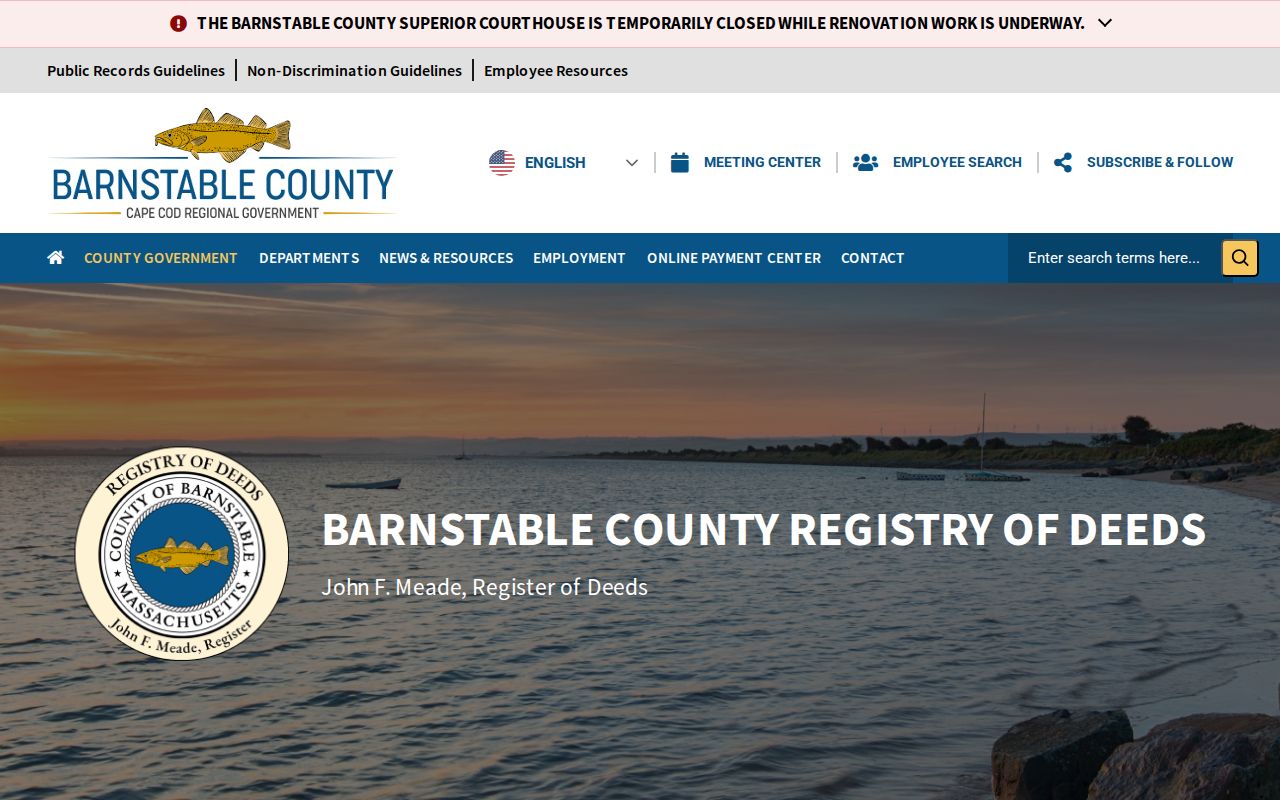
Free research images carry a “not an official copy” overlay. A clean image is listed at $1 per page, with a card convenience fee. The Registry counter and staff remain the documented fallback for missing images, unusual plans, or material that needs careful title review.
Falmouth Past Households in Directory Years
Directories put people near an address in selected Falmouth years. The Falmouth Public Library holds Bourne, Falmouth and Sandwich directories for 1900 and 1903. State Library and National Archives listings add 1908, 1926, and 1929 references, while Blue Books cover various years from 1908 through 1937. The Falmouth Street List begins in 1980. The gaps are real. Read both an alphabetical entry and an address or street section when the volume offers both, then preserve the name form, occupation or business clue, and exact village label shown in the volume.
The National Archives city-directory coverage list identifies the Barnstable, Falmouth, and Bourne directory context for the early twentieth-century trail.
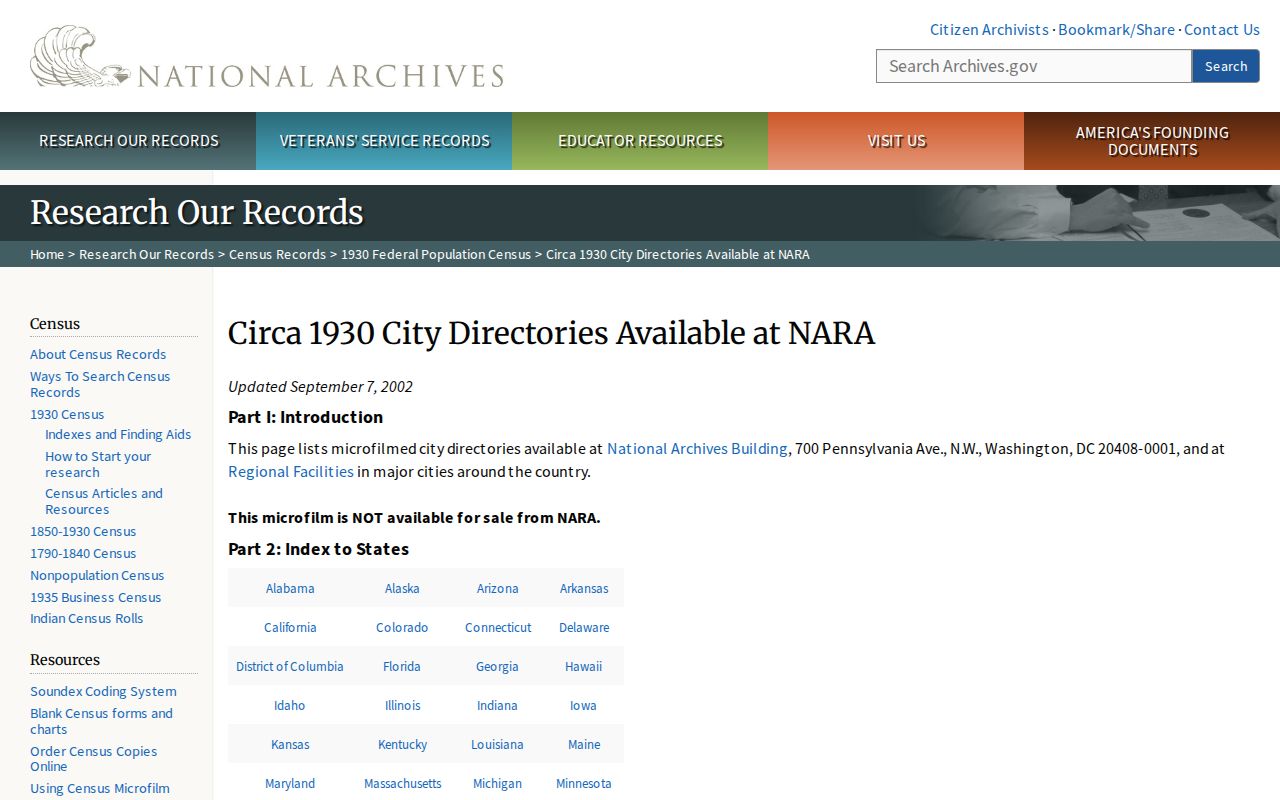
For shelf locations, publishers, and how to read a directory entry, use the Falmouth city directory resource. Here, the directory is only one dated stop in the backward address trail. A Blue Book can record a summer or resort connection, not a year-round household.
Falmouth Past Households and Census Pairing
Pair each directory hit with the nearest available federal census, but do not treat the two as interchangeable. The census gives a household on its enumeration date. A directory can capture an address, business, or listed resident nearer another year. Federal census releases follow the National Archives 72-year rule, with 1950 the latest public census in this research. Falmouth’s village and postal labels also make it important to search Falmouth Village, Woods Hole, East Falmouth, Teaticket, North Falmouth, and other historical place forms when the exact street string fails.
- Choose the directory year nearest the address event and inspect both name and street sections if present.
- Write down every name variant, initial, widow notation, occupation, and address form before moving to another record.
- Check the closest public census for household relationships, ages, and residence on its specific enumeration date.
- Use a deed, parcel plan, atlas, or Sanborn sheet to test whether the historical address is the modern parcel.
- Search the next available directory or Street List, not an assumed annual run, to mark a documented appearance or disappearance.
- Use an obituary, probate file, or later deed to explain a move, death, estate transfer, or household change when the records support it.
Note: A census and a directory can disagree because they were created for different dates and purposes, not because either record is automatically wrong.
Falmouth Past Households on Maps
Maps keep a past address connected to a physical place. Falmouth Public Library holdings include Sanborn sheets for 1901, 1906, 1914, 1923, and January 1930 through September 1942. They can show a building footprint, use, street context, and neighborhood change, but not a resident name. The legacy GIS adds historical aerial imagery for 1975, 1991, 2005, 2009, 2011, 2014 through 2016, 2018 through 2020. Falmouth Historic Commission survey material can add village, street number and name, construction date or style, parcel ID, and preservation status.
The Falmouth historic-district maps provide local village and historic-resource context for an address trail.
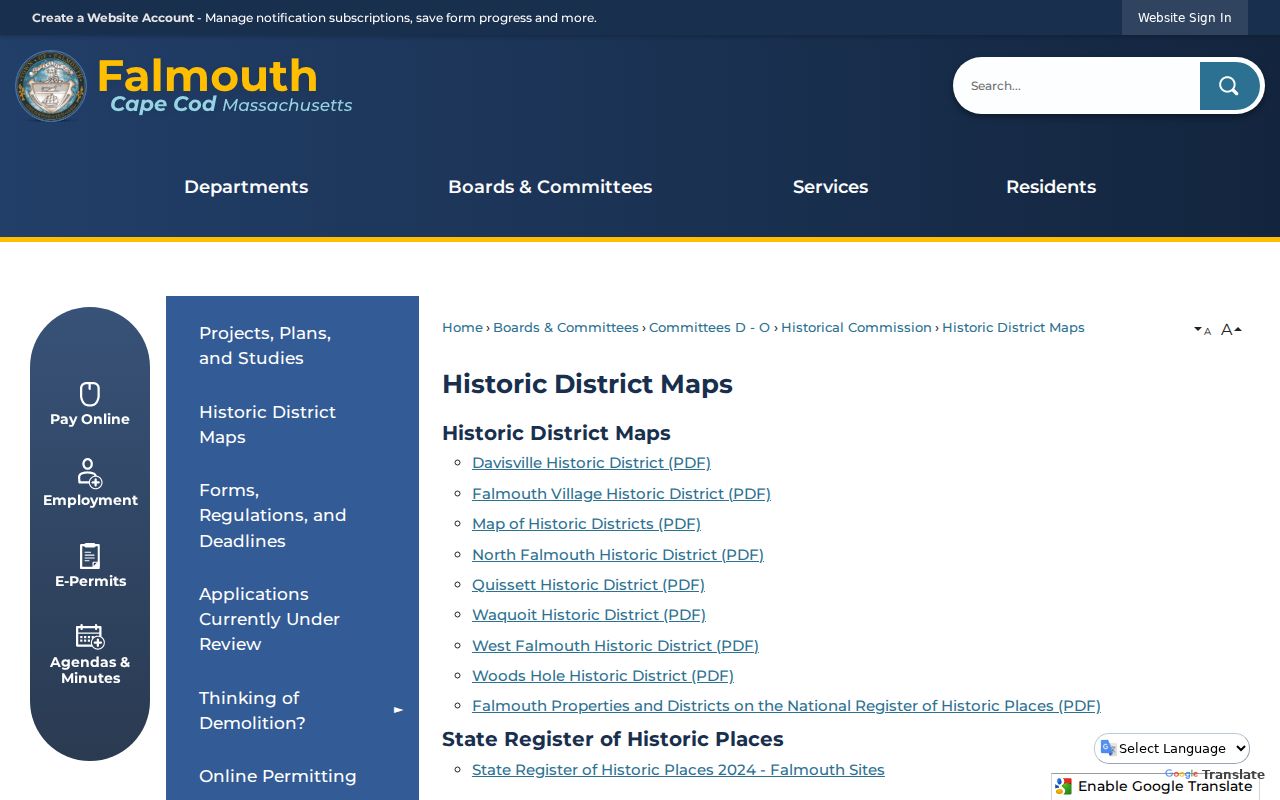
Map evidence helps bridge an old village label, a shifted road reference, or a split lot. It cannot replace the Registry legal description. No official source located a Falmouth-wide street-renumbering year, so a missing exact address needs map and deed comparison rather than an invented explanation.
Falmouth Past Households at Trail Endpoints
When a name drops from an address trail, local newspapers and estate records can explain the change. The Falmouth Enterprise runs from 1896 to the present, with online coverage from 1896 through 1962 and microfilm for the broader run. Its Mail Away Edition index covers 1932 through 1944 and 1946 through 1985 and focuses on local personalities and life. The Cape Cod Standard Times and Cape Cod Times add further date ranges at the library. These are useful for obituaries, marriage notices, property notices, and community events, but a notice is not a certified vital record.
Probate can identify an estate, fiduciary, heir relationship, address in filings, and dates that clarify a transfer. Barnstable Probate and Family Court commonly has online cases from 2000; older material requires a court archive or courthouse route, and the clerk or register holds the official public file. The Falmouth Historical Society’s Conant House research library and archives are another local channel, open by appointment year-round with Monday through Friday office hours from 10 to 3.
Falmouth Previous Residents Privacy Limits
Previous-resident research should distinguish a dated, recorded connection from a current location. Property records do not list all renters or household members. Utility customer information, DMV personal addresses, private school and library records, confidential-voter information, Address Confidentiality Program addresses, and sealed or juvenile court records are not normal house-history sources. A public name in an older directory or obituary also does not disclose a living person’s current address. Stop when the official trail stops, then use the documented library, archive, court, or Records Access Officer route for an existing record.