
Falmouth City Directory Collections
The strongest starting point is the Falmouth Public Library special-collections listing, especially its Lemcke Reference Room. It identifies a short but meaningful run of local volumes rather than a continuous town directory. The 1900 and 1903 Bourne, Falmouth and Sandwich directories place Falmouth in a shared Cape Cod volume. Later catalog and National Archives references point to selected years, while the library's Blue Books and Street List cover different periods and purposes. A city directory search should record the exact year and title before making a conclusion about a household.
| Collection | Years | Where Held | Access |
|---|---|---|---|
| Bourne, Falmouth and Sandwich Directories | 1900 and 1903 | Falmouth Public Library special collections | Library reference help; 1903 metadata is online |
| Falmouth directory references | 1900, 1903, 1908, 1926; NARA also lists 1929 | State Library catalog/reading room and NARA directory list | Year-specific holdings and research routes |
| South Shore and Cape Cod Blue Books | Various years, 1908-1937 | Falmouth Public Library | Local-history collection |
| Falmouth Street List | 1980-present | Falmouth Public Library | Confirm access limits before copying personal fields |
Those dates are landmarks, not proof of an uninterrupted series. The library does not claim that every intervening year survives. The Blue Books are especially different from a full-year resident roll because they include seasonal and resort-community material. The modern Street List is useful historical context, but its access and any copying limits should be confirmed with library staff. Note: A missing name may reflect a gap, a different town label, or the volume's purpose rather than a move.
Falmouth City Directory Runs by Year
The 1903 volume has a precise digital identification. The Osher Map Library record calls it Resident and business Directory of Bourne and Falmouth Massachusetts, 1903, gives A. E. Foss & Co. as publisher, and preserves its permanent landing page. That shared title matters when a surname is absent under a narrow Falmouth-only search. The National Archives circa-1930 directory list groups Barnstable, Falmouth, Bourne, and other Cape communities in several of the relevant years, so place names should be searched as well as surnames.
Early Falmouth city directories work best as a dated sequence: 1900 and 1903, then the documented 1908, 1926, and 1929 references, followed by the Blue Books in selected years and the Street List from 1980. A gap should remain a gap in the research notes. Do not turn the 1900-to-1903 pair into a claim of annual publication, and do not treat a seasonal Blue Book as a count of all year-round households.
Falmouth Library City Directory Shelf
The Lemcke Reference Room is more useful than a title list. A reference librarian can point a researcher toward the directories, newspapers, Street List, yearbooks, Sanborn maps, annual reports, and genealogy databases that fit a particular name or address. Falmouth Genealogical Society volunteers offer free drop-in help there on Tuesdays from 2:00 to 4:00 p.m. The library also holds Falmouth Enterprise material, including online issues from 1896 to 1962 and microfilm from 1896 forward, which can explain a household change found in a directory.
The library's own digitization notice points researchers to materials made available through Digital Commonwealth and Internet Archive. Use that route for digitized historical documents, then use the room's print, microfilm, and staff channels for the local items that are not presented as a complete online directory run. The library online-resources page is also the starting point for licensed newspaper and database access.
See the Falmouth Library special-collections source before planning a visit or asking for a volume. 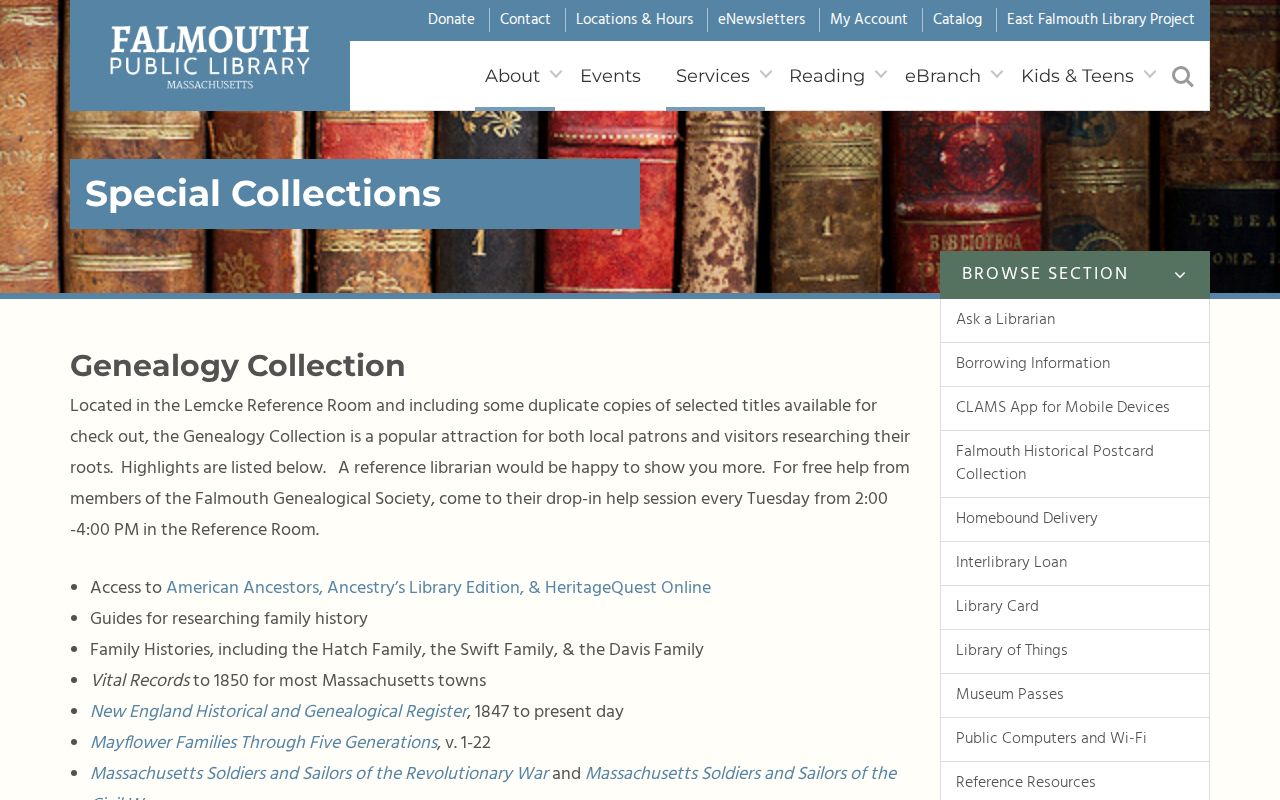 The collection screen helps distinguish a directory, a Street List, a newspaper run, and a Sanborn map before a surname search begins.
Reading a Falmouth City Directory Entry
A city directory entry must be read from the actual page, including its opening abbreviation list. The research confirms the 1903 title and publisher but did not expose page OCR or a verified entry field list. For that reason, the items below are an inspection inventory, not a statement that every item appears in the 1903 Falmouth volume. Capture only what the opened volume shows, preserving punctuation and unusual spelling.
| Person or household name | Copy surname, given name, initials, and any household wording exactly as printed. |
|---|---|
| Address or street reference | Record it only if the listing or its street section supplies it, then compare it with the volume's own street labels. |
| Occupation or business role | Note a role only when printed; it can help separate people with the same name. |
| Spouse, widow, or relationship notation | Preserve the notation rather than expanding it from a modern assumption. |
| Abbreviation or mark | Photograph or transcribe the volume's key before assigning meaning to a symbol. |
- Criss-cross directory
- A directory arrangement by street or address rather than by surname. No separate Falmouth reverse-directory title was confirmed, so inspect each volume for such a section.
- Householder index
- An alphabetical index that groups a household under a named person. It may not list every person at an address.
- Abbreviation key
- The volume's own list of shortened words and marks, usually near its front matter. Its meaning controls how the entry is read.
Tracing Falmouth City Directory Families
Begin with the directory year nearest the known address or family event. Search every spelling variant, including initials, maiden names, spouse references, and surname forms found in original records. Read the alphabetical listing and, if the volume has it, the street section. A change in address can be a useful lead, but it is not proof that a family owned the place. Pair the entry with a census schedule and then test the address against deeds, maps, or other records.
- Write down the volume title, year, page, spelling, and all wording from the first entry.
- Check the prior and next available directory years, without assuming the library holds every year.
- Read the street portion when present to see whether the address appears in the same volume.
- Pair 1900, 1903, 1908, 1926, and 1929 directory evidence with the nearest available federal census years.
- Use obituaries, marriage notices, yearbooks, probate, deeds, GIS, or Sanborn maps to test a disappearance, move, or house change.
Federal census schedules and city directories answer different questions. Census entries group people at an enumeration date, while a directory can identify a name, location, or local role in its publication year. The National Archives 72-year release rule means the 1950 census is public, while later schedules remain closed until their applicable release. For a current street-level parcel chain after a historical find, use the Falmouth street directory route rather than treating an old listing as current residence evidence.
Falmouth City Directory Companions
Falmouth High School yearbooks run from 1931 to the present and are nearly complete in library print and reverse-chronological digital form. They can support a classmate or family reconnection when a directory gap leaves only a name. The Falmouth Enterprise adds obituaries, marriage notices, civic reporting, and the Mail Away Edition index for 1932-1944 and 1946-1985. That index was designed around local personalities and life, not as a current address list.
Sanborn Fire Insurance maps offer a different companion. The library lists Falmouth editions from 1901, 1906, 1914, 1923, and January 1930 through September 1942. These maps can establish a building footprint, use, or street context around an entry, but they do not name occupants. Library oral histories provide a third layer: the Falmouth oral-history collection supports keyword, Boolean, and exact-match searching across interviews and related materials.
Falmouth Historical Directory Sources
The Falmouth Historical Society maintains a separate Research Library and archives at the c.1730 Conant House, 65 Palmer Avenue. Its holdings include family and local-history material, photographs, artifacts, and a research library of more than 700 volumes. It is independent of Town Hall, so a municipal-record request is not a substitute for an archive inquiry. The society states that research-library and archive access is by appointment year-round; its office hours are Monday through Friday, 10:00 a.m. to 3:00 p.m.
Consult the Museums on the Green research-library access information before arranging archival work. 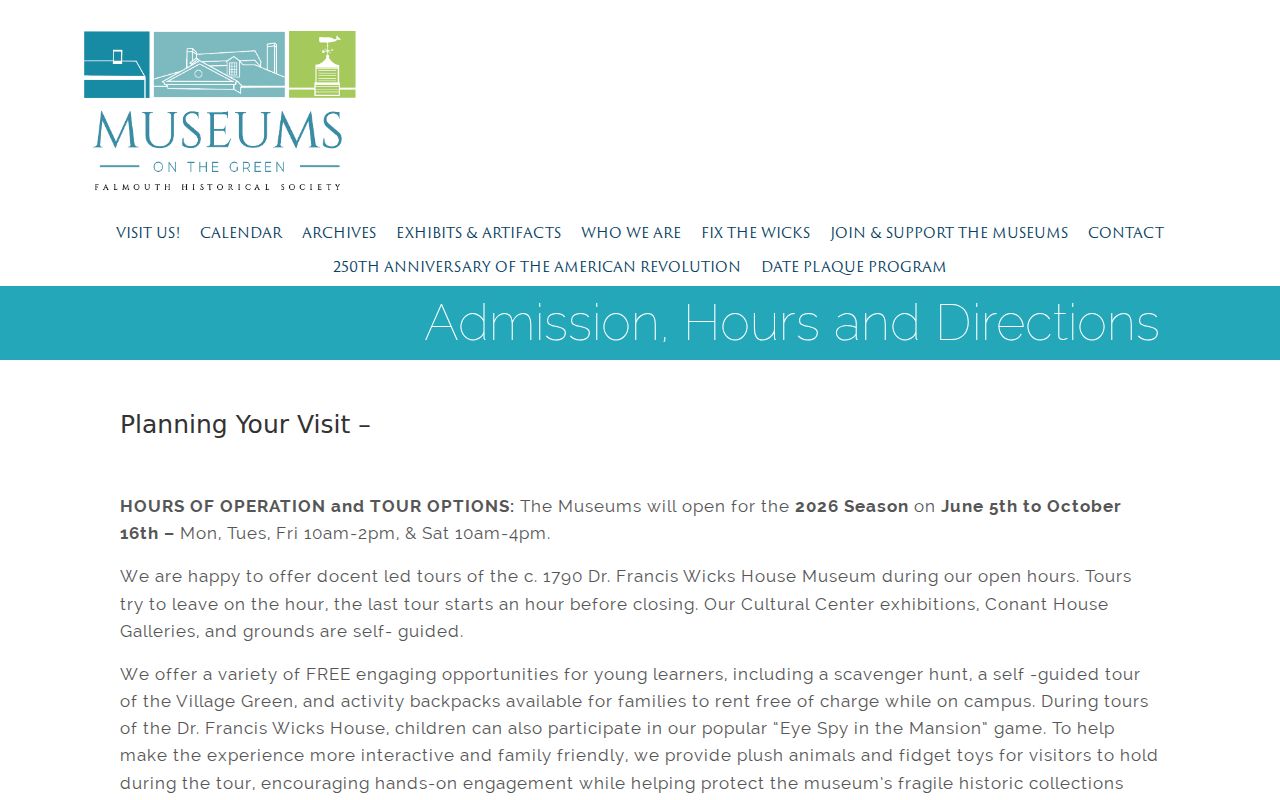 The appointment route is a useful fallback when a directory, family file, or photograph is not on the public library shelf.
Phone 508-548-4857 or use the society's published contact channel for collection questions. Bring the directory title, year, surname variants, and any town or village name already found. Note: Falmouth village labels can differ from modern mailing wording, so record the label used by the historical source.
Falmouth Directory Preservation Timeline
Falmouth's resident-record trail changes format rather than moving in one smooth line. The dated landmarks below help place a city directory result among the town's wider historical sources. They also explain why a researcher may need to move from a paper volume to a microfilm reel, a digitized document, or a modern Street List.
| 1792 forward | Library historical documents were later rebound and digitized through the local preservation project. |
|---|---|
| 1900 and 1903 | Bourne, Falmouth and Sandwich directory volumes are held as identified local directory years. |
| 1908-1937 | Blue Books appear in various years, with documented seasonal limits. |
| 1931 forward | Falmouth High School yearbooks provide a nearly complete local name trail. |
| 1980 forward | The Falmouth Street List supplies a modern annual list history at the library. |
A FY2025 town report also records a $7,500 LSTA grant for planning preservation of important library materials and documents. That is a current preservation initiative, not evidence that all historical holdings have been scanned. Ask the custodian which format is available for the exact year needed.